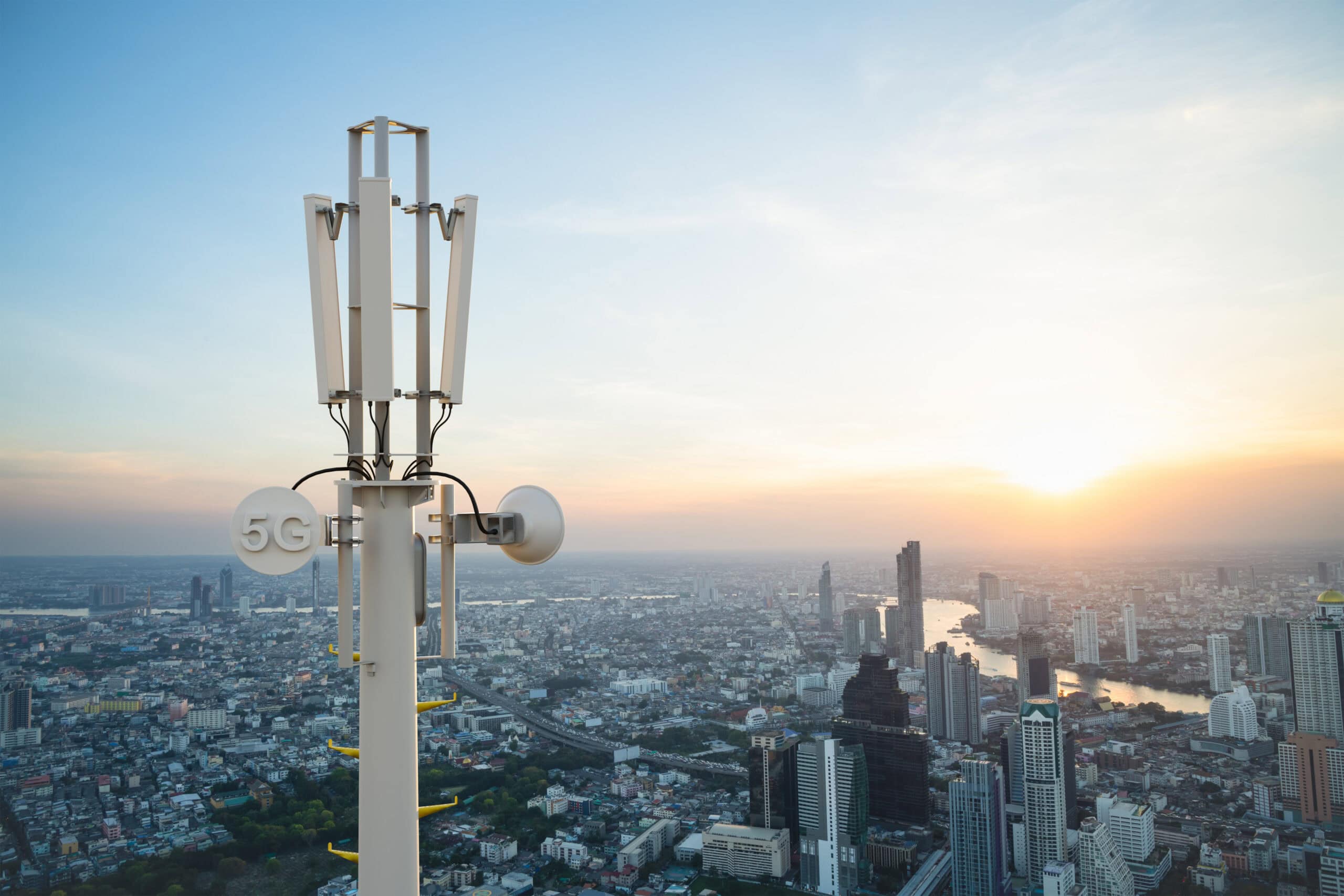
As 5G pushes power demands beyond what traditional cooling can handle, 5G thermal management has become one of the most critical – and most underestimated – challenges in modern network infrastructure.
Three problems define the 5G thermal challenge:
- Concentrated heat in limited space. GaN power amplifier modules generate substantial heat in a compact footprint, challenging conventional heatsinks – especially in sealed enclosures where airflow is unavailable.
- Unpredictable thermal spikes. Traffic bursts cause heat to surge within seconds. Systems designed for steady-state conditions fail at peak.
- Limited airflow paths. Sealed, IP-rated enclosures often restrict ventilation. Heat must be moved efficiently through interface materials, spreaders, chassis structures, and enclosure surfaces before it can be rejected to the ambient environment.
Understanding these challenges is the first step. The sections below address each one – and the thermal solutions that solve them.
Passive Cooling: Thermal Management Techniques
Passive solutions are a highly reliable, zero-power backbone of thermal design across 5G applications. The engineering challenge lies in recognizing exactly when they require mechanical supplementation.
Advanced Heat Sinks and Heat Pipes
Heat sinks and heat pipes provide high-efficiency heat transfer between solid interfaces. Advanced heat sink geometries can be used to address specific airflow conditions:
- Disrupting boundary layers
- Providing omnidirectional ventilation
- Maximizing surface area in constrained footprint spaces
Heat pipes can be embedded into aluminum or copper heat sinks to increase effective heat spreading and thermal transport, moving concentrated heat from 5G components to larger surface areas.
Thermal Interface Materials (TIMs)
A TIM fills the microscopic gaps between a heat source and its heatsink to cut thermal contact resistance. T-Global offers a range of TIM formats, including thermal pads, thermal grease, and phase change materials, each suited to different assembly and performance requirements.
Phase change materials (PCMs) offer a practical advantage in 5G applications. By reflowing under normal operating temperatures, they achieve minimal bondline thickness without requiring high assembly pressure. This phase transition can also provide a degree of transient thermal buffering during load changes, helping smooth the burst patterns that characterize 5G traffic. For components operating continuously inside sealed enclosures over a long deployment life, this combination of low interface resistance and cyclic-load performance can help reduce junction temperatures when validated in the final assembly.
Active Cooling and Thermal Orchestration
When passive methods reach their limits, active cooling provides the additional thermal capacity needed to maintain stable operation in high-density 5G deployments. T-Global offers several active cooling solutions designed for demanding telecom applications.
Cold Plates
For high-power 5G electronics where passive cooling is no longer sufficient, cold plates provide direct heat removal by circulating coolant through precision-engineered internal channels, transferring heat to a remote heat exchanger. T-Global designs and manufactures cold plates as part of its custom thermal module service, with channel geometry and form factor tailored to each application’s specific power and space requirements.
TEC / Peltier Modules
Thermoelectric cooling modules use the Peltier effect to actively move heat away from a component, enabling precise temperature control in compact spaces. T-Global’s TEC modules are well suited for precision electronics and temperature-sensitive systems where consistent operating temperatures are critical to performance.
Custom Thermal Modules
For applications where a single component is not sufficient, T-Global’s custom thermal module service combines cold plates, TEC modules, heat pipes, and vapor chambers into an integrated solution. Each module is developed to customer specifications, from initial design through sampling and manufacturing.
Liquid Cooling
Liquid cooling transfers heat efficiently because water-based coolants generally offer much higher heat capacity than air. In high-density 5G deployments, the resulting increase in efficiency is critical.
Direct-to-chip cold plates and full immersion setups are currently gaining serious ground in edge data centers. For engineers evaluating liquid cooling in telecom hardware, it’s important to consider the following:
- Leak risk management and containment strategies
- Fluid compatibility with internal system materials
- Pump reliability over extended deployment lifetimes
Looking Ahead: Thermal Management for Telecom, Industrial, and High-Frequency Applications
The thermal challenges defining 5G are already appearing in adjacent sectors, including industrial edge computing and AI inference hardware. Design teams across these categories share a common need for materials and system-level solutions that can manage heat reliably in variable operating environments. T-Global’s thermal portfolio, spanning TIMs, heat pipes, vapor chambers, and TEC modules, is designed to scale across these applications. The engineering foundations being built for 5G today are likely to carry forward directly into the higher power demands of 6G networks.
T-Global USA: Your Partner in 5G Thermal Management
Managing intense heat in modern infrastructure requires a strong thermal management strategy. Phase change thermal interface materials expertly handle transient load buffering, while advanced heat pipes efficiently move thermal energy. For extreme densities, liquid cooling takes over, and intelligent orchestration can tie the entire architecture together.
If your current design is running into thermal limits, T-Global USA is ready to help you identify the right materials to keep your hardware running safely. Request a quote or sample to start the conversation with our engineering team today.